
ARCHIVE ITEM #EF-JP-0132: Frequency 440 and the Oni Baby
[!CAUTION] ARCHIVE CASE: ANOMALY-1986-KLEENEX SUBJECT: THE CURSED 1986 JAPANESE TELEVISION SPOT LOCATION: TOKYO, JAPAN STATUS: CLASSIFIED / AUDITORY HAZARD
The 1986 Broadcast
In 1986, Kleenex released a television commercial in Japan featuring a woman dressed in a white robe (actress Keiko Matsuzaka) and a young child painted like a small red ogre, or oni, sitting on a pile of straw. The commercial was accompanied by the song "It's a Fine Day" by Jane and Barton. It seemed like a quirky, slightly surreal marketing campaign.
However, shortly after its broadcast, viewers began reporting intense feelings of dread, nausea, and disorientation. Rumors quickly spread that anyone who watched the commercial would fall ill or meet an early demise, and that the commercial had been pulled from the airwaves due to a deluge of complaints and mysterious occurrences surrounding the cast and crew.
 Source: Wikimedia Commons / ProtoKiwi, CC BY 4.0.
Analysis of the 'It's a Fine Day' Audio
At the heart of the anomaly lies the soundtrack: "It's a Fine Day." An a cappella vocal track recorded in a sparse, haunting tone, its simple melody became deeply unsettling when compressed for television broadcast.
Paranormal acoustic analysts suggest that the recording contained specific subliminal undertones or localized high-frequency hums that interacted with standard CRT television speakers, producing a binaural beat at approximately 440 Hz (and its disharmonious sub-harmonics). This frequency combination is known to induce mild auditory hallucinations, headaches, and physical feelings of anxiety in sensitive individuals. What was perceived as a supernatural curse may have been a profound demonstration of acoustic neurological resonance.
The Oni Baby Legend
The child character, styled as a red oni in straw clothing, triggered deep-seated archetypes in Japanese folklore. According to local urban legends, the child was not an actor but a real entity manifested on set, or a cursed doll that brought ruin to those involved.
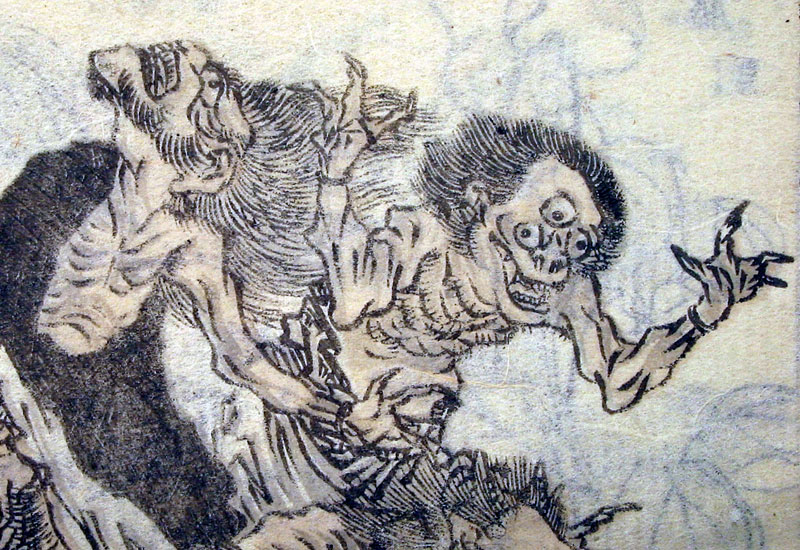 Source: Wikimedia Commons / Katsushika Hokusai, public domain.
Rumors claimed the young actor met a tragic, untimely end, and Keiko Matsuzaka was institutionalized or suffered a mysterious illness. While public records prove Keiko Matsuzaka remained active and healthy, the "Oni Baby" archetype acted as a psychological vector, embedding the commercial into the collective subconscious as a cursed artifact.
Mass Hysteria vs. Targeted Frequencies
Is the Kleenex commercial a genuine anomalous event, or a textbook case of mass sociogenic illness? The late 1980s in Japan was a fertile ground for urban legends, fueled by rapid technological advancement and a rising anxiety about digital media.
However, EtherealFiles investigators cannot dismiss the unique auditory profile of the broadcast. The combination of high-contrast visual editing, retro scanlines, and an unfiltered, looping a cappella track created a perfect storm of sensory overload. Whether triggered by supernatural forces or engineered frequencies, the 1986 broadcast stands as a stark warning of the power of transmitted media.
Senior Agent, EtherealFiles
DEBRIEFING NOTES
This report is part of the EtherealFiles initiative to document extra-terrestrial and paranormal phenomena. All findings are subject to verification by senior archives staff.
RELATED FILES

THE MAPIMÍ DEVIATION: Radio Silence and the 1970 Athena Missile Attractor
An audit of the localized atmospheric shield in Durango, Mexico, that terminates radio signals and unnaturally pulled...

FILE 23-G: The Acoustic Shadow of Overtoun
Why do dogs leap to their deaths from a specific spot on a 19th-century bridge? We investigate the thin veil at Overtoun.

PROJECT RADIAL: The Lead Masks of Vintém Hill
Two men, formal suits, and lead eye-shields. Their final notebook entry spoke of capsules and a 'signal.' What were t...